Have you explored the bible stories stories and reflections on signs below our windows? There’s more information about each of the windows below.
If you enjoyed the reflections, there are short daily audio reflections from Richard, one of our Rectors, at a few words.
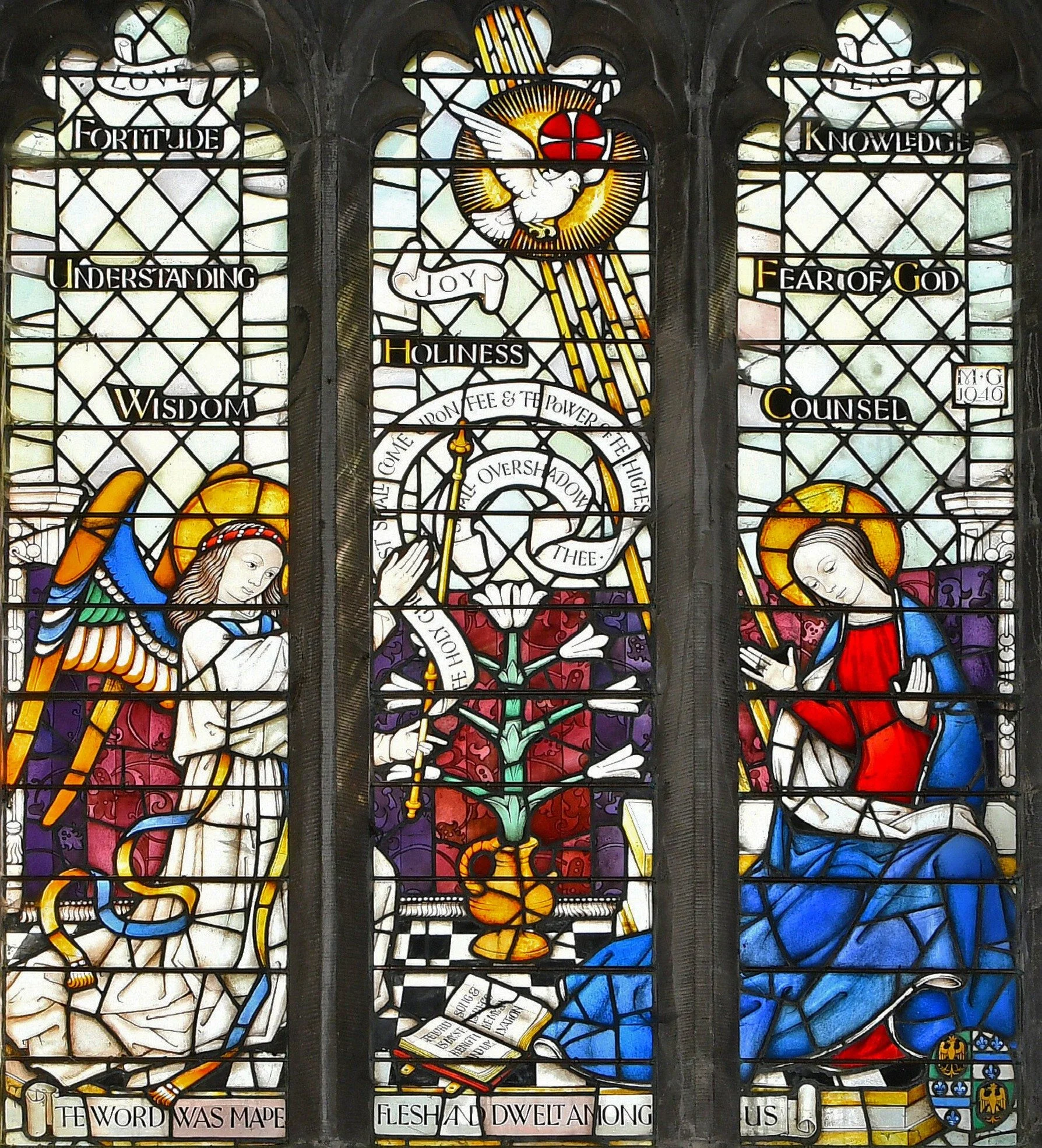
The Annunciation
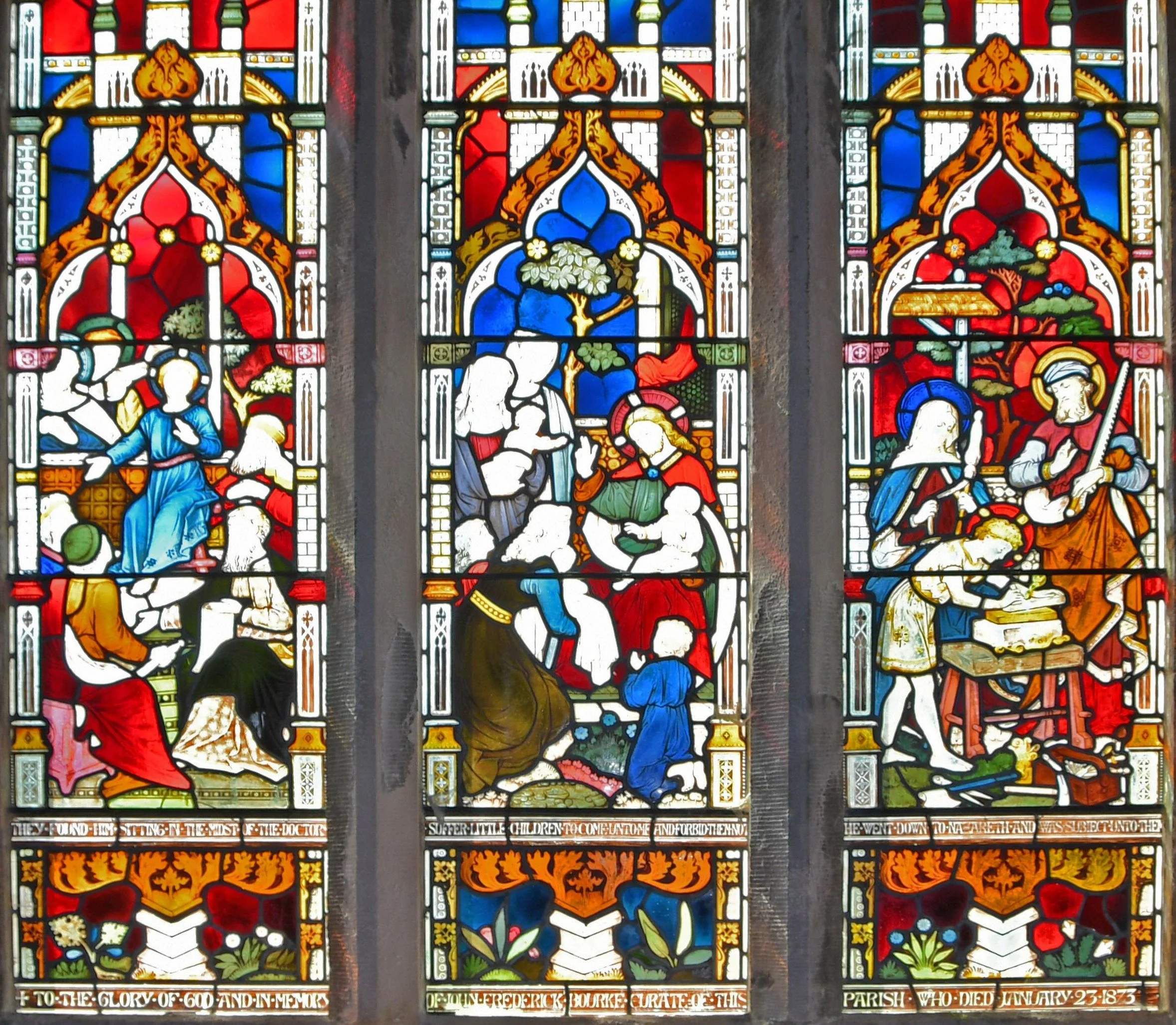
Children and the Early Life of Jesus
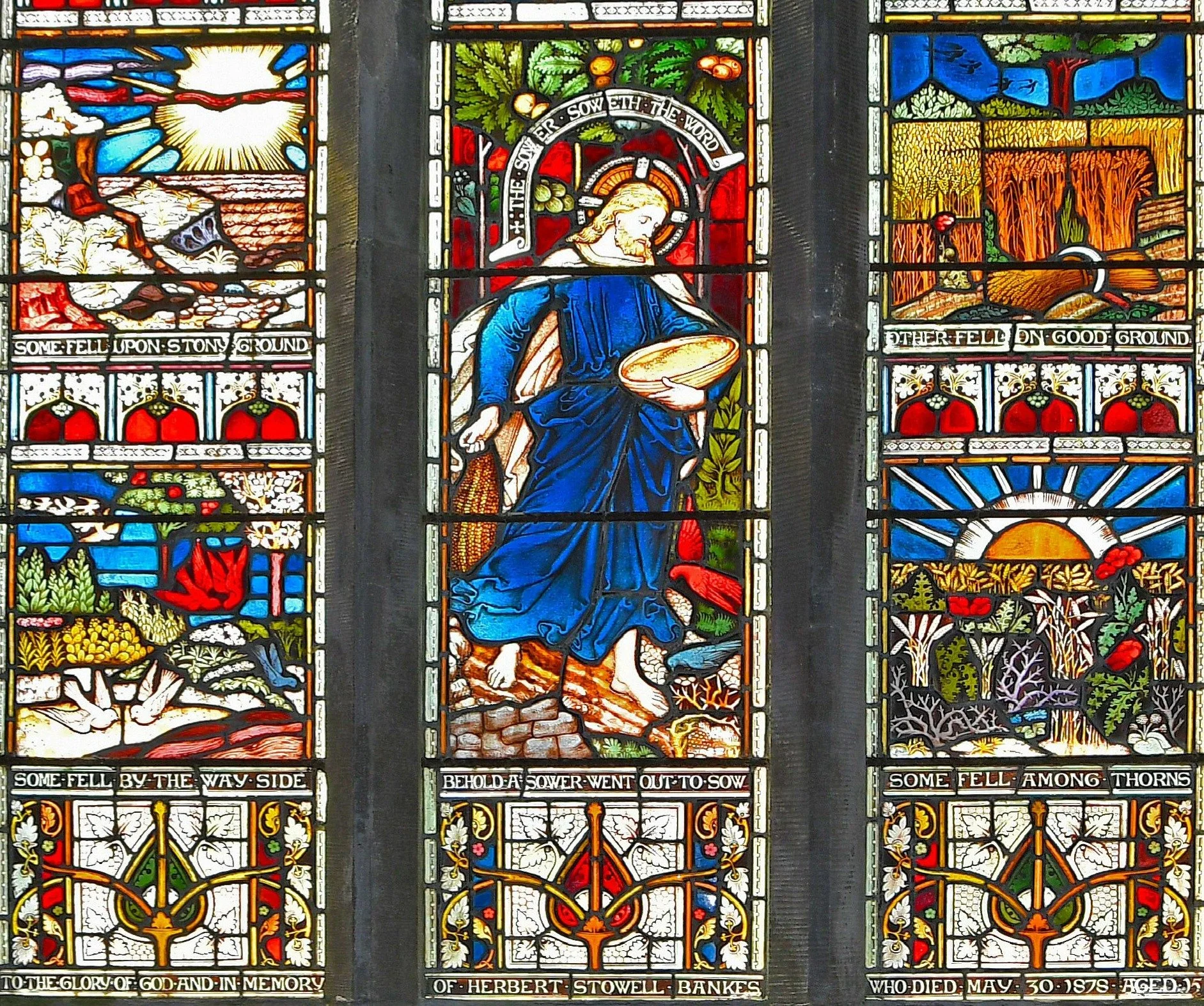
Parable of the Sower
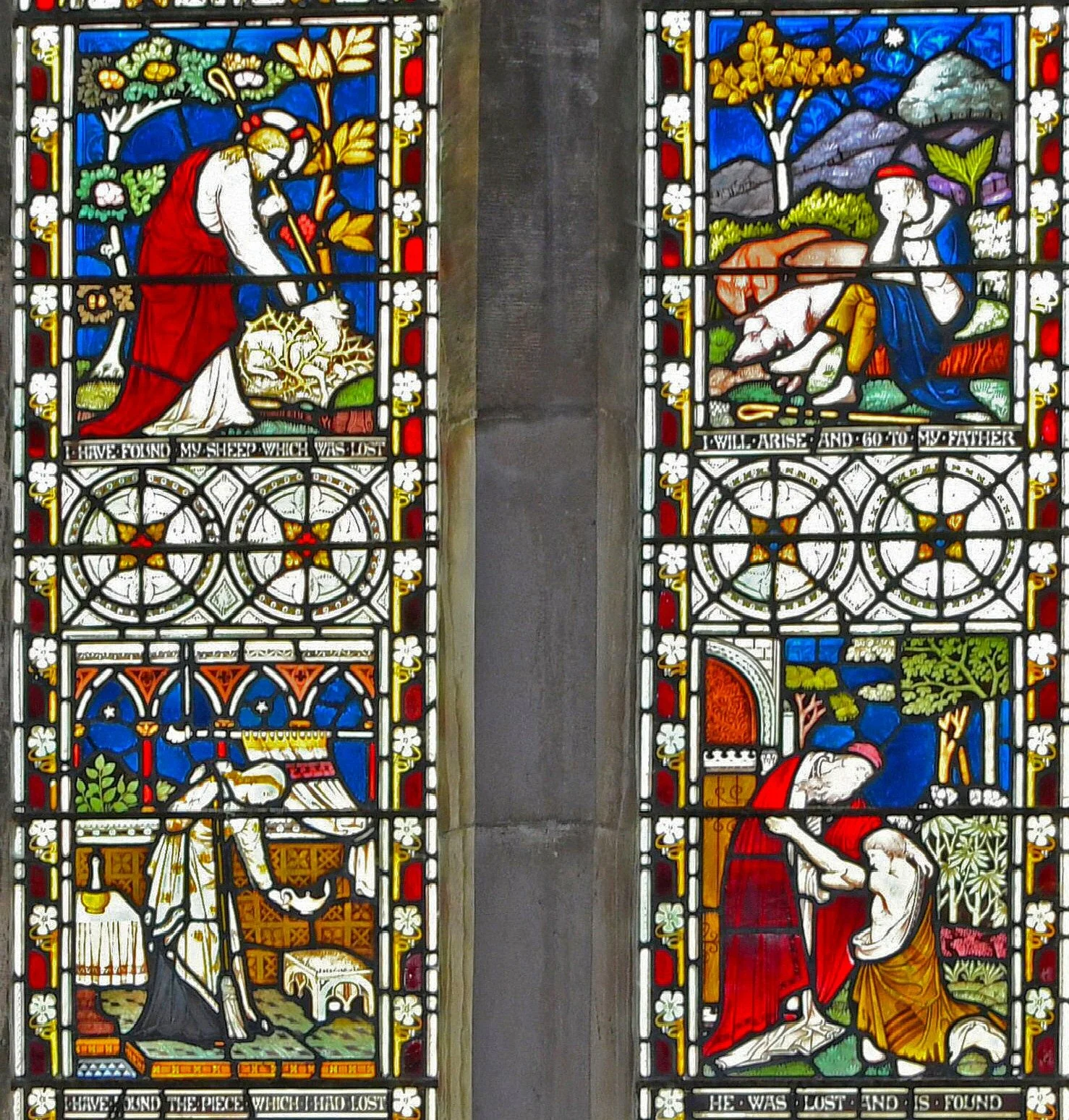
Three Parables from Luke
Two Parables from Matthew
The Calming of the Storm

The Crucifixion

The Resurrection
The Risen Jesus

St Edward
-
St Edward’s contains a remarkable collection of Victorian and early twentieth-century stained glass, much of it commissioned by the Bankes family, who owned Corfe Castle throughout the nineteenth century. Several windows were later extended or redesigned by the architect and designer Martin Travers, whose assistant Laurence Lee completed the work after Travers’ death in 1948.
The descriptions below follow the windows in order around the church. Scripture references are from the New Testament unless otherwise noted.
There are photos of the full windows here
-
Chapel, East Wall (717)
This window depicts the moment the Angel Gabriel comes to Mary of Nazareth with an extraordinary message: she is to conceive a son through the Holy Spirit, to be called Jesus — a name meaning ‘God saves’ — who will be a king whose reign will never end.
The angel holds a gold sceptre representing Jesus’ royal authority. From the hand of God above, the Sacred Dove descends towards Mary, representing the Holy Spirit. The angel’s scroll carries the words of Luke 1:35: THE HOLY GHOST SHALL COME UPON THEE AND THE POWER OF THE HIGHEST SHALL OVERSHADOW THEE.
Mary kneels with open hands — a gesture of acceptance and submission to God’s will. At her feet lies a book open at a verse from Exodus (15:2): THE LORD IS MY STRENGTH AND MY SONG IS BECOME MY SALVATION. A vase of lilies stands nearby; in Christian art, the lily is the flower most closely associated with Mary, representing purity.
The rays of light carry the seven gifts of the Holy Spirit, each named on a scroll woven through the window: wisdom, understanding, counsel, fortitude (spiritual strength), knowledge, holiness, and fear of God. These are the gifts which the prophet Isaiah said would characterise God’s promised Saviour (Isaiah 11:2–3).
The inscription below the window reads: THE WORD WAS MADE / FLESH AND DWELT AMONG / US (John 1:14).
History
The window was begun in 1944 by the architect and designer Martin Travers, who also redesigned the East End window (700) in 1947. He died in 1948 and both windows were completed by his assistant Laurence Lee. The heraldic blazon at the lower right of the window identifies the donor, Marjorie Graves, who died in 1946 having left money in trust for the window.
-
Vestry, South Wall (704)
This window of three panels depicts scenes from the boyhood and youth of Jesus, framed above by ornamental stonework containing the letters IHC — an ancient abbreviation of the name of Jesus Christ in Greek — flanked by two small angels with scrolls, one of which reads ALLELUIA.
Jesus in the Temple (Luke 2:46): The twelve-year-old Jesus sits among the teachers and scholars in the Jerusalem Temple, listening, questioning and astonishing them with his understanding of religious law. It is the first moment in the Gospels where Jesus gives any indication that he understands himself to be the Son of God. The inscription below reads: THEY FOUND HIM SITTING IN THE MIDST OF THE DOCTORS.
Suffer the Little Children (Luke 18:16): Jesus welcomes children brought to him for blessing, and rebukes his disciples for trying to turn them away. The old English word ‘suffer’ here simply means ‘allow’ or ‘welcome’. The inscription below reads: SUFFER LITTLE CHILDREN TO COME UNTO ME, AND FORBID THEM NOT.
Jesus the Carpenter (Luke 2:51): Jesus works alongside Joseph in the carpenter’s shop at Nazareth. The trade, the obedience to his parents, and the humble background are all woven through the Gospels as essential to understanding who Jesus was and what he came to do. The inscription below reads: HE WENT DOWN TO NAZARETH AND WAS SUBJECT UNTO THEM.
The lower decorative panels show gold acanthus sprays in white pots. In Christian art, vegetation of this kind evokes the Heavenly Garden, and acanthus in particular — with its characteristically thorny leaves — symbolises rebirth and the overcoming of sin.
TO THE GLORY OF GOD AND IN MEMORY / OF JOHN FREDERICK BOURKE CURATE OF THIS / PARISH WHO DIED JANUARY 23RD 1873
-
South Aisle (706)
This window of three main panels depicts one of Jesus’ best-known parables, found in Matthew 13:1–23, Mark 4:1–20 and Luke 8:4–8.
In the central panel, Jesus scatters seed across a field. The inscription above reads THE SOWER SOWETH THE WORD; the inscription below reads BEHOLD A SOWER WENT TO SOW. The four surrounding panels show where the seed falls:
Top left: rocky ground, with the inscription SOME FELL UPON STONEY GROUND.
Lower left: a bare path where two birds eat the grain, with the inscription SOME FELL BY THE WAYSIDE.
Top right: good soil, with sheaves of wheat lying on brown earth, and the inscription OTHERS FELL ON GOOD GROUND.
Lower right: a field of thorn bushes, with the inscription SOME FELL UPON THORNS.
Jesus explains that the seed is God’s word. The different soils represent different ways of receiving it — some lose it immediately, some receive it with joy but fall away under pressure, some let anxiety and distraction choke it. But those who receive it with an open and persevering heart, he says, will bear fruit beyond all expectation.
History and dedication
The window is attributed, though not with certainty, to the glaziers Clayton and Bell, and was probably commissioned in 1878 as a memorial to Herbert Stowell Bankes, who died that year aged fifteen. He was the son of the Rector Eldon S Bankes, who had overseen the substantial restoration of the church in 1859.
TO THE GLORY OF GOD AND IN MEMORY / OF HERBERT STOWELL BANKES / WHO DIED MAY 30 1878 AGED 15
-
South Aisle (708)
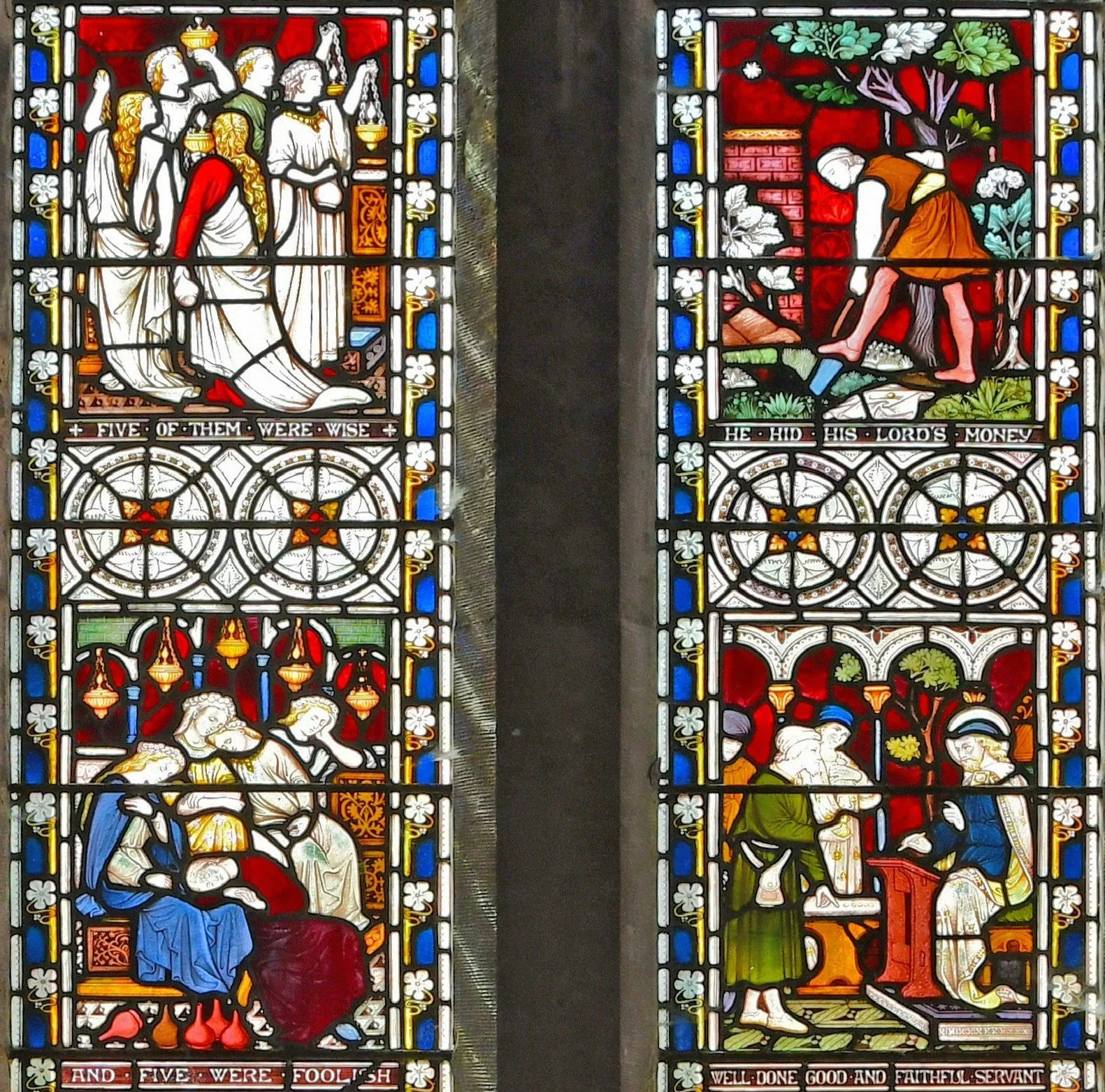
This window presents two parables from Matthew 25, both concerned with readiness and the use of what we have been given.
The Wise and Foolish Bridesmaids (Matthew 25:2–13): Ten bridesmaids wait through the night for a bridegroom who is delayed. Five have thought ahead and brought spare oil for their lamps; five have not. When the bridegroom finally arrives, the unprepared five find their lamps failing and miss the celebration entirely. The top panel shows the five wise bridesmaids, each holding both a lamp and a jar of oil, with the inscription FIVE OF THEM WERE WISE. The lower panel shows the five foolish ones asleep, their lamps hanging above them and the oil jars empty on the floor, with the inscription AND FIVE WERE FOOLISH. The parable is a call to keep the inner life attended to, and not to assume there will always be more time.
The Parable of the Talents (Matthew 25:14–30): A master gives three servants different sums of money — five talents, two, and one — before going on a journey. The servants with five and two talents invest and double their money; the one with a single talent buries it out of fear. On his return, the master praises the first two and rebukes the third. The top panel shows the servant digging in the garden to bury the talent, with the inscription HE HID HIS LORD’S MONEY. The lower panel shows all three servants before their master, whose nimbus (halo) indicates that we are to understand him as God, with the inscription WELL DONE GOOD AND FAITHFUL SERVANT.
Memorial
Both windows were commissioned by the same bereaved father, and a brass plaque on the wall between them carries his dedication:
THESE TWO WINDOWS WERE PUT UP BY / A SORROWING FATHER TO THE MEMORY / OF A BELOVED CHILD, LOUISA BANKES / WHO DIED NOVEMBER 15TH 1882 AGED 23 / ‘So he giveth his beloved sleep.’ Psalm 127:3 / ‘Blessed are the pure in heart for they shall see God.’ Matthew 5:8
-
South Aisle (707)
This window presents three parables from Luke 15, all telling the same story in different keys: something precious is lost, searched for with care, and found — and when it is found, there is a celebration.
The Lost Sheep (Luke 15:3–7): A shepherd with a hundred sheep leaves the ninety-nine to search for the one that has strayed, and carries it home on his shoulders. The inscription reads: I HAVE FOUND MY SHEEP WHICH IS LOST. Jesus is frequently described in the Gospels as the Good Shepherd; the parable presents God as one for whom no individual is too insignificant to search for.
The Lost Coin (Luke 15:8–10): A woman with ten silver coins loses one and lights her lamp to sweep every corner of her house until she finds it. The inscription reads: I HAVE FOUND THE PIECE WHICH WAS LOST.
The Prodigal Son (Luke 15:11–32): A young man squanders his inheritance, ends up destitute and envying the pigs their food, and finally comes to his senses. He sets out for home intending to ask his father for work as a servant. The inscription below the first panel reads: I WILL ARISE AND GO TO MY FATHER. But when the father sees him approaching while he is still a long way off, he runs to meet him. The inscription below the second panel reads: HE WAS LOST AND IS FOUND. The older brother, who has stayed faithful, is jealous of the welcome — and is gently rebuked. The parable is one of the most complete portraits of unconditional love and forgiveness in all of literature.
Dedicated to the memory of Louisa Bankes, who died 15th November 1882.
-
Tower (710)
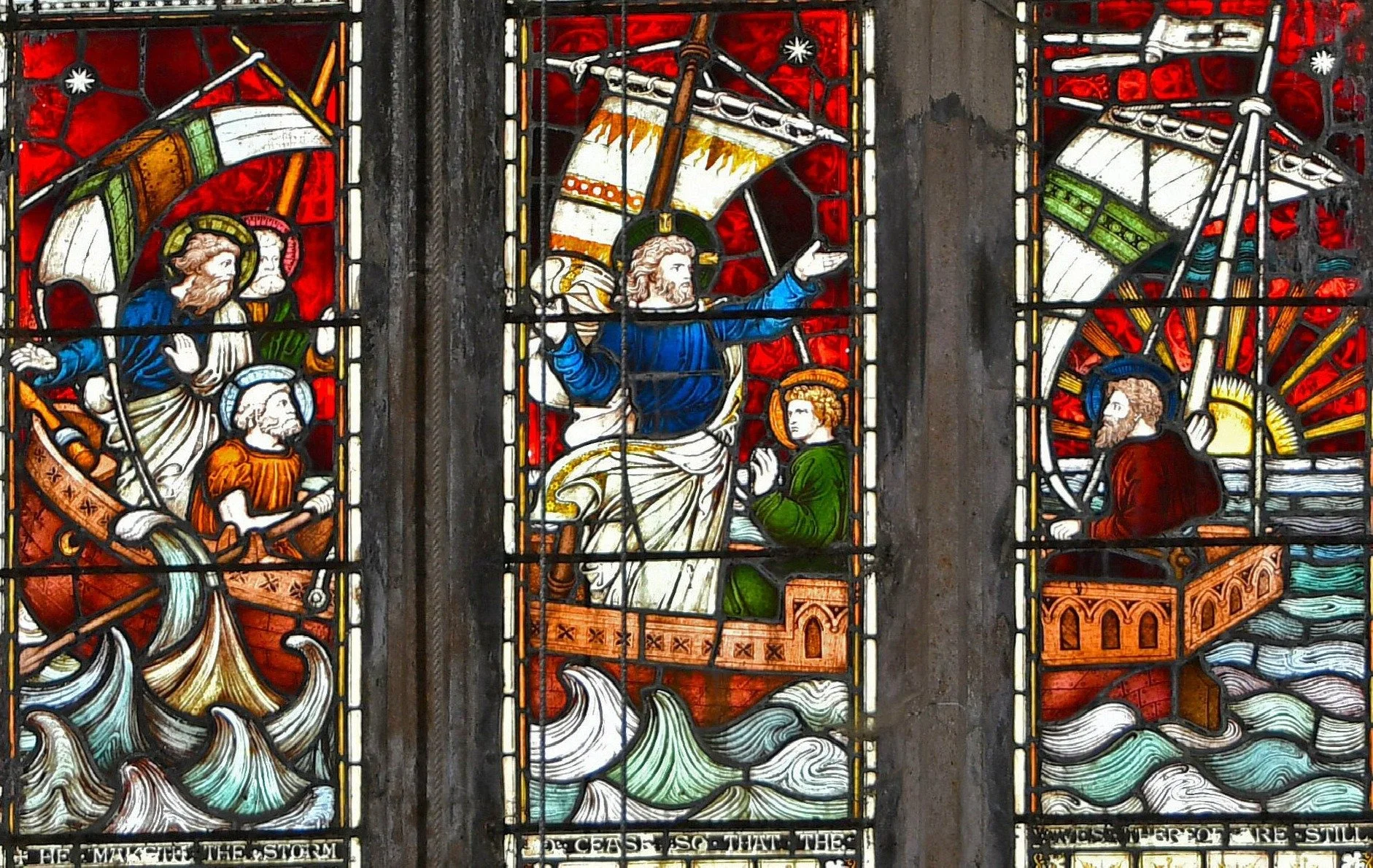
This window narrates one of Jesus’ miracles, taken from Mark 4:35–41. The story is told across three panels read left to right: the boat in a stormy sea; Jesus standing in the boat with arms outstretched, commanding the wind and the waves; the boat in a calmed sea. The inscription below reads: HE MAKETH THE STORM / TO CEASE SO THAT THE / WAVES THEREOF ARE STILL.
Jesus and his disciples have pushed out from shore, and Jesus — exhausted — has fallen asleep in the stern. A fierce squall sweeps in. The disciples, several of them experienced fishermen who know exactly how dangerous this is, wake him in a panic: ‘Don’t you care that we are perishing?’ Jesus speaks to the storm: ‘Peace. Be still.’ The wind drops and the sea becomes calm. He turns to his disciples and asks: ‘Why were you so afraid? Do you still have no faith?’ They are left asking one another: ‘Who is this — that even the wind and the waves obey him?’
Memorial
A brass plaque below the window is dedicated to Captain Sir George Biddlecombe, a naval officer of considerable distinction whose career spanned the circumnavigation of the globe in 1823, the Siege of Oporto in 1832, the Capture of Acre in 1840, and several other engagements. He served as Master of the Fleet at the Capture of Bomarsund in 1854, and retired as Master Attendant of Her Majesty’s Dockyards at Keyham and Woolwich in 1867. He died on 19th July 1878 aged 70 and was buried at Kingston. His connection with Corfe Castle came through his two marriages, both to women whose mothers were from the parish.
-
Chapel, North Wall (715)
The central panel shows Jesus on the cross, with Mary Magdalene kneeling at its foot keeping faithful watch. In Western Christian art the Virgin Mary is traditionally depicted in a blue cloak; the figure shown here is not wearing one, which indicates that this is Mary Magdalene rather than Jesus’ mother.
At the base of the cross, a yellowish boulder may represent a skull — a reference to Golgotha, the Place of the Skull, the site outside Jerusalem where the crucifixion took place.
The upper circular (quatrefoil) panel shows an angel appearing to three women who have come to the tomb with spices to anoint Jesus’ body: the Virgin Mary (in blue), Mary Magdalene, and Martha, all devoted followers throughout his ministry.
The lower panel shows the Entombment. Joseph of Arimathea, a member of the Jewish council, and Nicodemus, a scholar who had previously come to Jesus secretly by night, wrap Jesus’ body in clean linen and spices and lay it in Joseph’s own unused tomb. The Virgin Mary and the disciple John stand watching.
Both lancet windows in the Chapel are among the earliest installed after the substantial rebuilding and renovation of the church in 1859.
FOR A MEMORIAL OF / CAROLINE BRADLEY / WHO DIED ON GOOD FRIDAY / 10TH APRIL 1857
-
Chapel, North Wall (714)
The central panel of this tall lancet window depicts the risen Jesus emerging from the tomb in white and gold robes, holding the banner of the Resurrection — a symbol of victory over death familiar in Western Christian art. Notice the marks of the nails still visible on his hands and feet: the wounds are there deliberately, to show that this is not a different or transformed figure but the same Jesus who was crucified, now alive.
A soldier lies sleeping at his feet, a common detail in depictions of this scene.
In the upper circular (quatrefoil) panel, the risen Jesus appears to Mary Magdalene, who had remained at the tomb. In the lower panel, he blesses a young man, possibly one of the disciples.
IN MEMORY OF EDWARD / AND / ELIZABETH GOVER 1864
-
Chancel, East End (700)
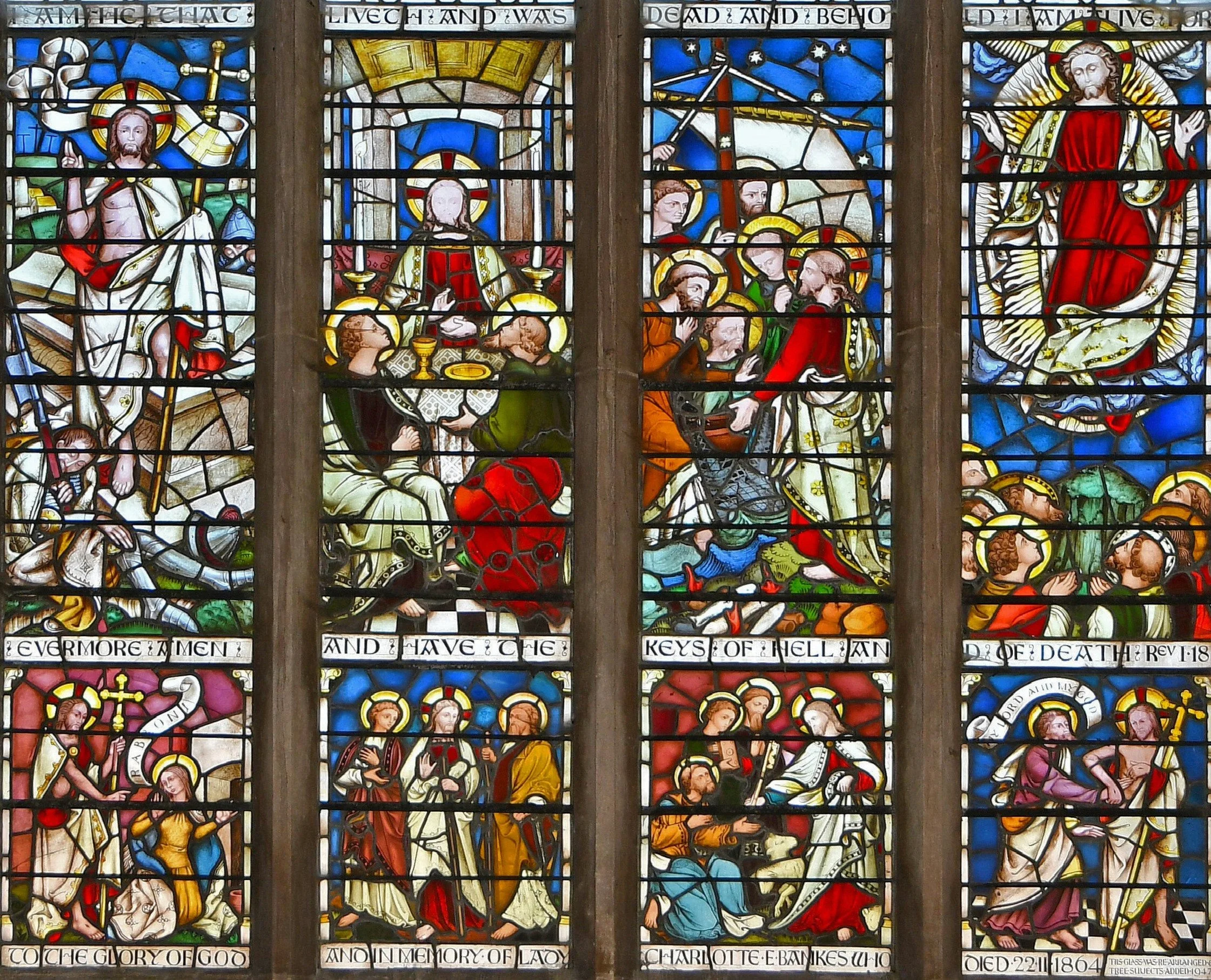
This large window of four main panels and eight illustrated scenes traces the story of Jesus in the days after his resurrection — his appearances to his disciples, and his final Ascension into heaven.
Upper panels (left to right)
The Resurrection: Jesus rises from the stone tomb, staff in hand, his right hand raised in blessing. A soldier sleeps at his feet — a detail common in Western depictions of this moment.
The Supper at Emmaus (Luke 24:16–31): Two disciples have been walking and eating with a stranger who suddenly reveals himself as the risen Jesus. The scene captures the instant of recognition — the moment the stranger is known in the breaking of the bread, an image at the heart of Christian worship.
The Meal on the Shore (John 21:4–14): Five disciples return from a failed night’s fishing to find Jesus already on the beach, with fish and bread prepared. At his word, their nets fill with a miraculous catch. The scene carries a double message: that God provides for physical as well as spiritual needs, and that the risen Jesus is no ghost but a bodily, present reality.
The Ascension (Luke 24:50–53): Jesus is taken up into heaven in a blaze of light, watched by his disciples. The text below these four panels is taken from the Book of Revelation (1:18): EVERMORE AMEN / AND HAVE THE / KEYS OF HELL AN / D OF DEATH.
Lower panels (left to right)
Christ Appears to Mary Magdalene (John 20:12–18): Mary Magdalene stands weeping at the empty tomb, then turns to find Jesus beside her. She calls out ‘Rabboni’ — Teacher — the word inscribed on the scroll above her head. The Gospels present her as the first witness of the risen Christ, the first to carry the news of the resurrection.
The Walk to Emmaus (Luke 24:13–18): The same two disciples from the Supper at Emmaus are shown here earlier in the day, walking with a stranger they do not yet recognise as Jesus. The panel sits directly below the Supper scene, telling the story in sequence.
Christ Presents the Keys to St Peter (Matthew 16:19): Peter — who had been a fisherman named Simon before Jesus called him — is given spiritual authority over the church, symbolised by the Keys of Heaven. Jesus asks him three times whether he loves him; each time Peter says yes, Jesus gives the same commission: ‘Tend my sheep.’ The threefold question mirrors Peter’s threefold denial at the crucifixion, and turns it into a restoration.
Doubting Thomas (John 20:24–29): Thomas had refused to believe in the resurrection without physical proof. Here, Jesus places Thomas’s hand against the wound in his side. Above Thomas’s head is a scroll bearing his response: ‘My Lord and my God’ — one of the most direct declarations of faith in the Gospels.
History and dedication
The original nineteenth-century window dates from around 1864, probably made by the glaziers Clayton and Bell, and is dedicated to Lady Charlotte E Bankes who died that year. The Bankes family were owners of Corfe Castle throughout the Victorian period. The original window had only three panels. In 1947 the architect Martin Travers redesigned it to its present four-panel form; he died in 1948 and the work was completed by his assistant Laurence Lee.
TO THE GLORY OF GOD / AND IN MEMORY OF LADY / CHARLOTTE E BANKES WHO / DIED 22 11 1864
A small inscription at the lower right reads: ‘This glass was re-arranged and three subjects added 1947
-
Vestry, South Wall (705)
This single tall lancet window depicts the saint to whom this church is dedicated. Edward stands before a castle representing Corfe Castle, wearing the crown and sword of kingship and the halo of sainthood. In his right hand he holds a cup — a reference to the cup of wine he was allegedly given as part of his murder.
Edward the Martyr was King of England from 975 to 978, killed at Corfe Castle at the age of around fifteen, almost certainly on the orders of his stepmother. He was venerated as a saint soon after his death. According to local tradition, this church stands on the site of a cottage where his body was brought immediately after the murder.
FILIUS IN MEMORIAM PATRIS / DILECTISSIMI HANC DEDICAVIT (‘The son dedicated this to the memory of his beloved father’)